
 Muni's Play
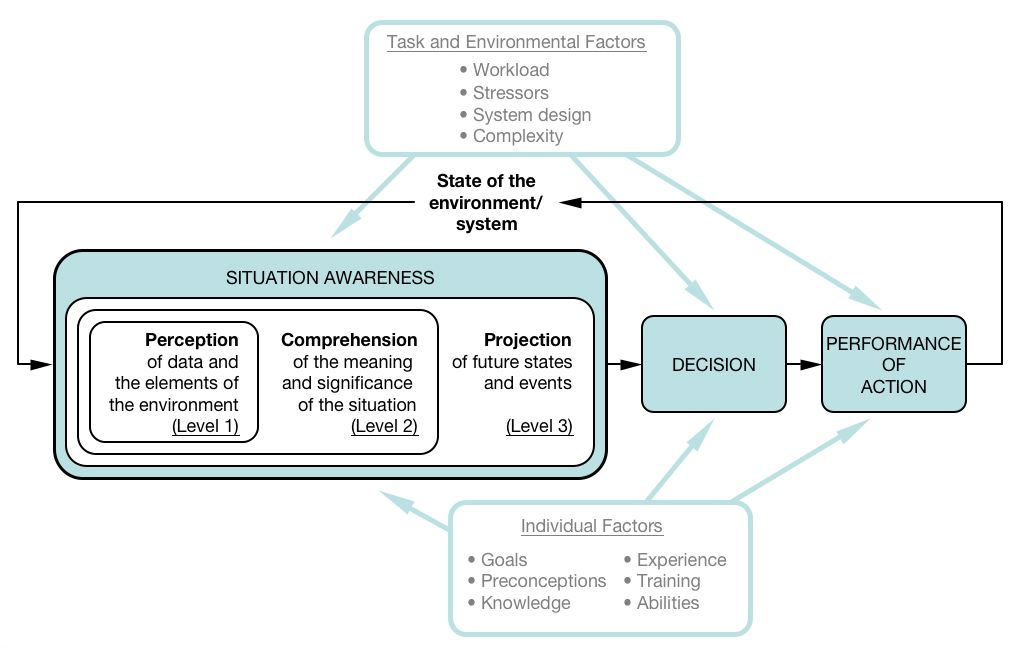 Public Domain, https://en.wikipedia.org/w/index.php?curid=11319693
The Three Levels of Situation Awareness
Endsley outlines a hierarchical formation of SA:
- Perception (Level 1 SA): The basic monitoring, cue detection, and recognition of the status, attributes, and dynamics of elements in the environment.
- Comprehension (Level 2 SA): Synthesizing disjointed Level 1 elements via pattern recognition and evaluation. This helps build a comprehensive picture to understand how the situation impacts one’s goals.
- Projection (Level 3 SA): Extrapolating Level 1 and 2 information forward in time to anticipate the future actions of elements and how they will alter the environment.
Key Cognitive Mechanisms
- Goals and Attention: SA relies heavily on both goal-directed (directing attention) and data-driven (information “grabbing” attention) processing.
- Mental Models and Schemas: Given the strict limits of working memory (especially for novices), experts rely heavily on long-term memory expectations, mental models, and pattern matching to prototypical schemas. This permits rapid integration of information and single-step retrieval of appropriate actions.
- Temporal & Spatial Dynamics: SA is inherently dynamic, changing at a tempo dictated by elements, tasks, and environments, and relying on spatial knowledge of the activity.
Factors Influencing SA
Several variables can negatively or positively affect SA development:
- System and Interface Design: The capability of a system to convey information clearly and transparently.
- Automation: Highly automated systems can severely reduce SA (creating “out-of-the-loop” performance problems) by forcing users into passive monitoring roles where cognitive engagement is reduced and vigilance fades.
- Workload: High workload/stress (overload) and underload (vigilance conditions) both negatively impact SA.
- Complexity: Complex situations make forming accurate mental models difficult.
- Individual Differences: Experience and training are foundational for building mental models, but innate differences (e.g., spatial abilities, multi-tasking skills) mean individuals will develop varying levels of SA even with identical training.