
 Muni's Play
The Mind Illuminated
The Mind Illuminated is a comprehensive guide to meditation, integrating Buddhist teachings with modern cognitive science.
The Ten Stages & Four Milestones
The Novice Meditator
- Stage One: Establishing a Practice
- Stage Two: Interrupted Attention and Overcoming Mind-Wandering
- Stage Three: Extended Attention and Overcoming Forgetting
Milestone One: Continuous Attention to the Meditation Object
The Skilled Meditator
- Stage Four: Continuous Attention and Overcoming Gross Distraction and Strong Dullness
- Stage Five: Overcoming Subtle Dullness and Increasing Mindfulness
- Stage Six: Subduing Subtle Distraction
Milestone Two: Sustained Exclusive Focus of Attention
The Transition
- Stage Seven: Exclusive Attention and Unifying the Mind
Milestone Three: Effortless Stability of Attention
The Adept Meditator
- Stage Eight: Mental Pliancy and Pacifying the Senses
- Stage Nine: Mental and Physical Pliancy and Calming the Intensity of Meditative Joy
- Stage Ten: Tranquility and Equanimity
Milestone Four: Persistence of the Mental Qualities of an Adept
Quotes
Quote
Meditation is the art of fully conscious living.
My Notes
The Five Core Insights of Vipassanā
Vipassanā (Insight) is not intellectual, but an experientially-based, deeply intuitive realization that shatters conventional beliefs. The five most important insights are:
- Impermanence
- Emptiness
- The nature of suffering
- Causal interdependence of all phenomena
- The illusion of the separate self (“no-Self”)
Realization requirements:
- The first four insights are experienced using stable attention (samādhi) and mindfulness (sati) to investigate phenomena (dhamma vicaya) with persistence and energy (viriya).
- The fifth insight (no-Self) is the culminating realization that actually produces Awakening. This requires both the first four insights and that the mind be in a state of śamatha (filled with deep tranquility and equanimity).
Seven Factors of Awakening & Śamatha/Vipassanā
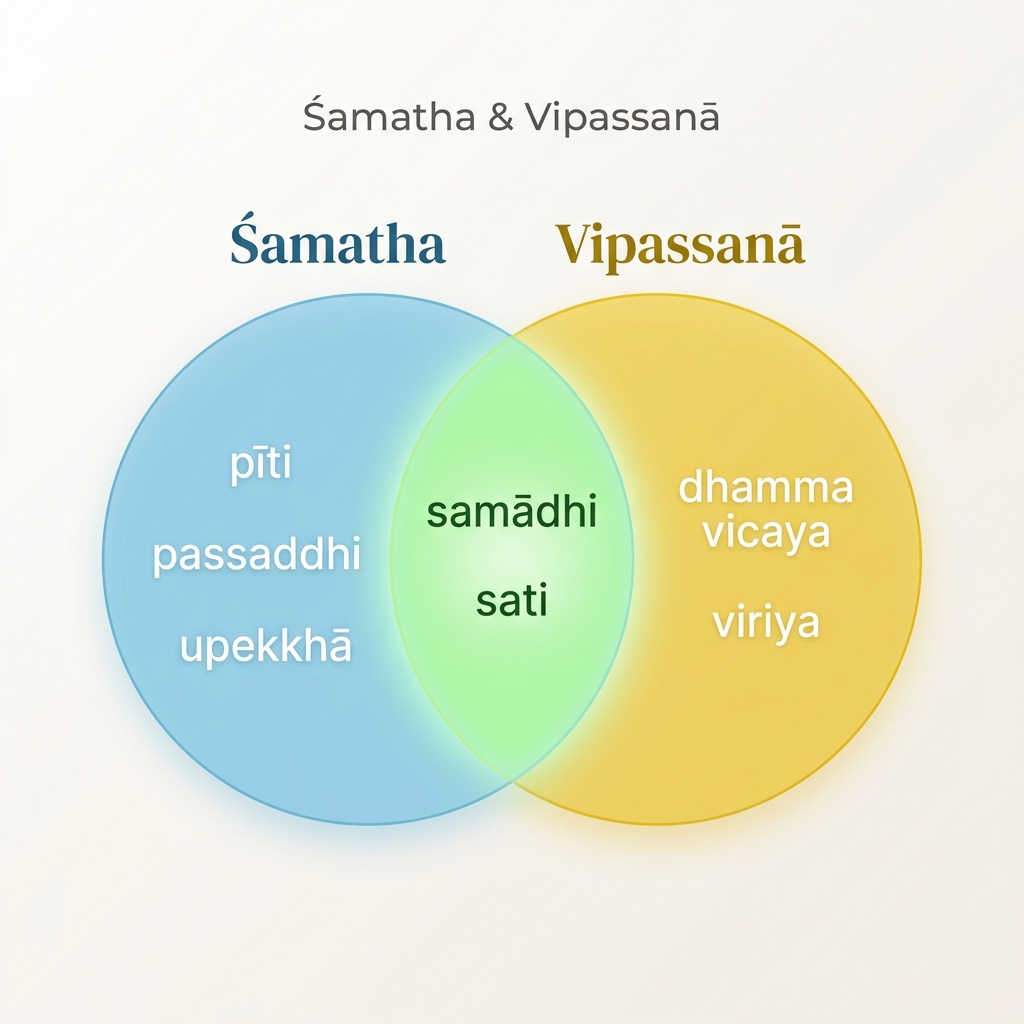
The seven factors needed for Awakening (satta bojjhangā in Pali, sapta bodhyanga in Sanskrit) are samādhi, sati, pīti, passaddhi, upekkhā, dhamma vicaya, and viriya.
The first five are characteristics of śamatha: samādhi, sati, pīti, passaddhi, and upekkhā. Four factors are required for vipassanā: samādhi, sati, dhamma vicaya, and viriya. Two factors, samādhi and sati, are common to both śamatha and vipassanā. So, the combination of śamatha and vipassanā provides all seven factors of Awakening.
Seven Factors of Awakening Venn Diagram
A mind in a state of śamatha is ripe with the potential for both vipassanā and Awakening, requiring only that phenomena be investigated (dhamma vicaya) with persistence (viriya). Likewise, a mind with vipassanā requires only śamatha for Awakening to occur.
Quote
Samatha has five characteristics: effortlessly stable attention (samadhi), powerful mindfulness (sati), joy, tranquility, and equanimity. The complete state of samatha results from working with stable attention and mindfulness until joy emerges. Joy then gradually matures into tranquility, and equanimity arises out of that tranquility. A mind in samatha is the ideal instrument for achieving Insight.
Śamatha Followed by Vipassanā
graph LR
    samadhi[Samādhi] --> flow["Śamatha + Diligent Investigation<br>(viriya & dhamma vicaya)"]
    sati[Sati] --> flow
    flow --> vipassana[Vipassanā]
    vipassana --> awakening([Awakening])
Vipassanā Followed by Śamatha
graph LR
    samadhi[Samādhi] --> flow["Vipassanā + Tranquility and Equanimity<br>(passaddhi and upekkhā)"]
    sati[Sati] --> flow
    flow --> samatha[Śamatha]
    samatha --> awakening([Awakening])
The Two Major Objectives of Meditation Practice
The two major objectives of meditation practice are stable attention and mindfulness:
- Stable Attention: The ability to intentionally direct and sustain the focus of attention, as well as to control the scope of attention.
- Its opposite is spontaneous movements of attention. Attention moves spontaneously in three different ways: scanning, getting captured, and alternating.
- Mindfulness: The optimal interaction between attention and peripheral awareness, which requires increasing the overall conscious power of the mind.
Strategy:
- Sustaining Attention Through Following and Connecting
- Cultivating Introspective Awareness Through Labeling and Checking In
Six-Point Preparation for Meditation
A structured routine to prepare the mind and body before each session, covering motivation, goals, expectations, diligence, distractions, and posture:
- Fire up your motivation
- Set reasonable goals
- Beware of expectations
- Commit to diligence
- Review potential distractions
- Adjust your posture
The Four-Step Transition to the Meditation Object
A progressive narrowing of the focus of attention:
- Focus on the present
- Focus on bodily sensations
- Focus on bodily sensations related to the breath
- Focus on sensations of the breath at the nose
Formula for Joy and Relaxation
Relax and look for the joy; observe; let it come, let it be, and let it go.
Formula for Suffering
Suffering = Pain × Resistance ()
The amount of suffering you experience is equal to the actual pain multiplied by the mind’s resistance to that pain.
Four Levels of Mindfulness
- Level One: Moderating behavior
- Level Two: Becoming less reactive and more responsive
- Level Three: Reprogramming deep conditioning
- Level Four: Mindfulness, insight, and the end of suffering